The exosome platform
Alongside its autologous cellular therapy, BrainStorm is advancing a proprietary, allogeneic exosome-based platform designed to deliver therapeutic proteins and nucleic acids.
05
Exosome biology
Exosomes are nano-sized cell-derived vesicles - typically 30–120 nm - secreted by all cell types.
They are notably stable, and may provide enhanced cell-to-cell delivery of bioactive molecules across the blood–brain barrier into regions of the brain that are otherwise difficult to reach. Their cargo carries out important regulatory functions in many cell processes, including immunomodulation and neuroprotection.
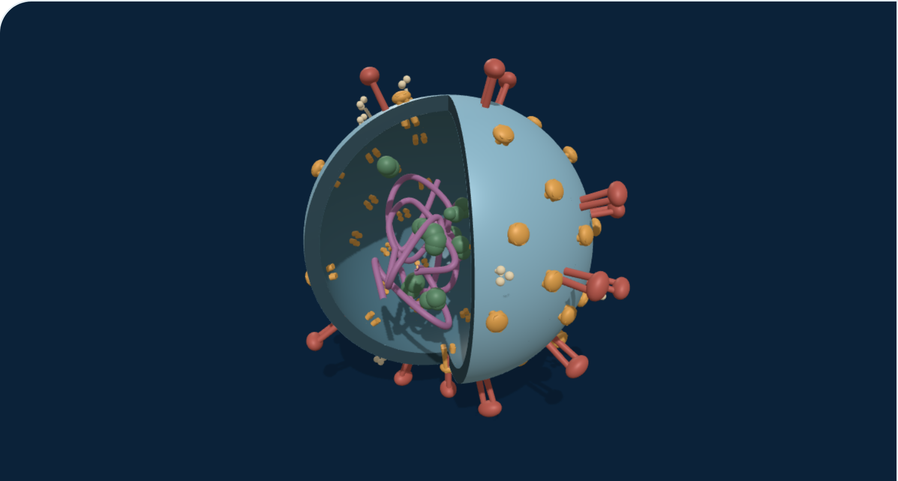
Loads an interactive 3D model.
Drag to rotate · scroll to zoomSwipe across to rotate · pinch to zoom
Parts
- Lipid bilayer
- A two-layer membrane about 5 nm thick, enclosing everything.
- Tetraspanins
- CD9, CD63, CD81 - the markers used to confirm a preparation is exosomes.
- Integrins
- Adhesion receptors that influence which tissues a vesicle docks with.
- Surface glycans
- Branched sugars involved in how other cells recognize the vesicle.
- Protein cargo
- In BrainStorm’s exosomes: at least one of LIF, VEGFA and GDF-15.
- microRNA
- Short RNA strands carried in the lumen alongside the protein cargo.
Illustrative model, not a micrograph. Bilayer, tetraspanins, integrins and glycans are general exosome biology; the LIF, VEGFA and GDF-15 cargo is what BrainStorm has described in its own exosomes.
Composition
BrainStorm’s exosomes
BrainStorm’s exosomes are not a generic preparation. They are isolated, through a proprietary process, from the secretome of the same MSC-NTF cells that underpin NurOwn® - and they are produced in bioreactors rather than one patient at a time.
Defined cargo
Each preparation carries at least one of the neurotrophic factors LIF, VEGFA and GDF-15, and may contain additional proteins or microRNA molecules.
Characterized
The exosomes express characteristic exosomal and MSC markers, and are isolated in a process developed in-house.
Source: BrainStorm press release, 3 December 2024, describing the composition and method claims of the allowed U.S. patent.
Approach
Allogeneic, not autologous
NurOwn is autologous: every dose is grown from the bone marrow of the patient who will receive it. The exosome platform is being developed as a potential allogeneic product - made once, for many.
That difference is the point of it. An allogeneic product offers simplified long-term storage and transport, and may facilitate repeat dosing in chronic disease, delivered non-invasively. Those are the properties that a patient with a progressive neurodegenerative condition would feel, and they are difficult to achieve with a therapy manufactured individually.
Evidence
Preclinical results
The work published to date is preclinical. In a mouse model of lipopolysaccharide-induced acute respiratory distress syndrome, intratracheal administration of MSC-NTF-derived exosomes produced a statistically significant improvement across multiple lung parameters:
Functional recovery
Measured improvement in lung function.
Less inflammation
Reduction in pro-inflammatory cytokines.
Less damage
Attenuation of lung damage.
In the same study, MSC-NTF-derived exosomes showed a superior effect to exosomes derived from naïve mesenchymal stem cells taken from the same donor - evidence that the differentiation step, not the cell source alone, is doing the work.
Source: BrainStorm press release, 23 July 2020. The findings were subsequently published in two peer-reviewed papers, both listed under Publications.
Protection
Intellectual property
The Australian Patent Office granted patent 2019252987, Cell-Type Specific Exosomes and Use Thereof, covering an isolated exosome population derived from MSC-NTF cells and a pharmaceutical composition for treating neurodegenerative diseases. It was the company’s first granted patent for MSC-NTF cell exosomes. The Israel Patent Office allowed the same claims under application 277447, with an acceptance date of 1 December 2023.
In December 2024 the U.S. Patent and Trademark Office issued a Notice of Allowance for a foundational patent covering the composition and method of the platform. That patent is expected to provide protection until 10 April 2039, subject to standard term adjustments.
Status
Current development focus
The company’s primary focus remains the development of NurOwn for ALS, as it prepares to initiate a Phase 3b registrational trial. The exosome platform is being advanced alongside it, and BrainStorm has said it is pursuing strategic collaborations to develop it further.
Source: statement by Chaim Lebovits, President and Chief Executive Officer, 3 December 2024.
Read next
- 02
MSC-NTF cells
The cells the exosomes are derived from, and how they are differentiated to secrete high levels of neurotrophic factors.Read more - Science
The platform, in five parts
Autologous cellular therapy, MSC-NTF cells, cell production, the exosome platform and the intellectual property behind them.Back to Science
BrainStorm's autologous MSC-NTF cell therapy (NurOwn®, debamestrocel) is investigational and has not been approved by the FDA or any other regulatory authority.